

FROM AROUND THE WORLD


Is Loyola’s Growth Spurt Into Edgewater Ending?
June 16, 2014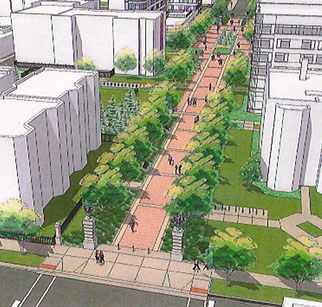 Loyola University has been undergoing a huge growth spurt. From their new green “people street” on Kenmore to the Montserrat rental properties on Sheridan & Albion and their co-sponsoring of the Loyola Red Line station, Loyola has spent over $660 million just on their lake front campus in the last ten years.
This burst of growth is fairly recent. Surprisingly, the catalyst for it was the 2008 recession; it created both cheap funding and construction firm availability. Originally, Loyola had planned to start three construction projects in 2008, but they ended up with ten new projects. The expansions shouldn’t have been a complete surprise though. The university has been growing by leaps and bounds; the student body has increased by 40% in the last twelve years.
Luckily, many of these new construction projects are finally being finished. Not surprisingly, the constant construction has not been the easiest for community members or students. The people street project, for example, has obstructed a block of Kenmore for two years, sending students and bike riders into alleyways and creating more pedestrian and cyclist congestion on Winthrop, which was already affected by the loss of parking and driving space inherent in the project. Happily, the construction will finish on schedule in August, giving bikers a few months to enjoy it before winter. While there are not any current solid plans for a grand opening celebration, it will be highlighted along with other Edgewater landmarks during September’s 5K.

The new Loyola red line station improvements – including a plaza space, an update of the station’s appearance and improvements to the viaduct – were completed last year. Jennifer Clark, Loyola’s associate Vice President of Campus and Community Planning is particularly excited about the “Summer on the Plaza” that they are co-sponsoring along with the CTA, the Rogers Park Business Alliance, the Sheridan Road SSA, and Joe Moore, the 49th Ward Alderman. Along with a weekly farmers’ market, it will feature musical events, exercise classes, and bike clinics. The full schedule for June (although not July-October as mentioned) is on their website.
These two projects along with the Montserrat also mark the end of large-scale construction that affects the community. Their newest campus plan released in March focuses on extensive building renovations with any potential construction centered in the heart of the campus.
So what about the space they recently bought on Broadway? Clark described it as “an emergency situation and in foreclosure, (Loyola) bought it to stabilize the site.” The school currently does not plan to build on Broadway south of Rosemont and will probably swap it with a commercial landlord for another property under a 1031 exchange, an IRS procedure that allows two individuals or organizations to trade property much like baseball cards.
We invite you to comment as Edgeville Buzz's GUEST. We review all submissions before they go live on our site. We encourage civil dialogue. Posts must adhere to our comment policy and we reserve the right to delete posts/ban users for instances of inappropriate language, bullying speech, character defamation, spam, etc.
-
bdickus2001
-
Jmn
-
-
Scott
-
Jmn
-
James
-
-
-
ooggg

.......................................

.......................................

.......................................

.......................................

.............................................

